Web Design Company Toronto — Websites Built to Rank and Convert
Digitex Crew is a web design company in Toronto — our studio is in North York at 1315 Finch Ave W — building fast, SEO-friendly websites for small businesses across the GTA. As a full web development company serving Toronto, we pair clean design with local SEO so your site ranks for the searches that matter and turns visits into calls.
Fixed CAD quotesSEO-first buildsToronto office — 1315 Finch Ave W
What Does a Web Design Company Do?
A web design company plans, designs, and builds the website your business runs on: page structure, visual design, content placement, forms, and the technical setup that makes it load fast and rank on Google. Good agencies also handle hosting guidance, analytics, and ongoing updates after launch.
At Digitex Crew that means one accountable team for strategy, design, code, and SEO — not a designer who hands off to a developer you've never met. We plan the pages around the searches your customers run, write and place the content so it converts, and ship a site you can actually edit. That full scope is what separates a web design firm from a freelancer who only draws mockups.
Case studies
Real Websites We Designed & Built
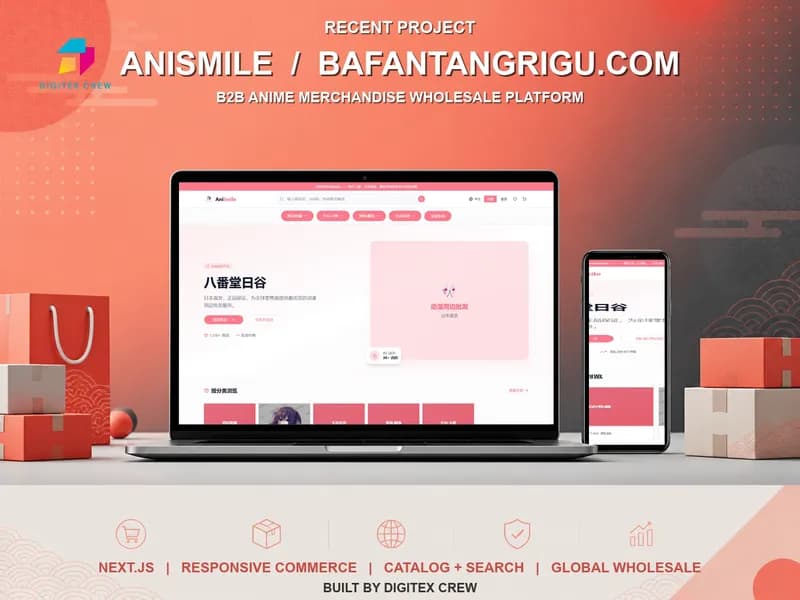
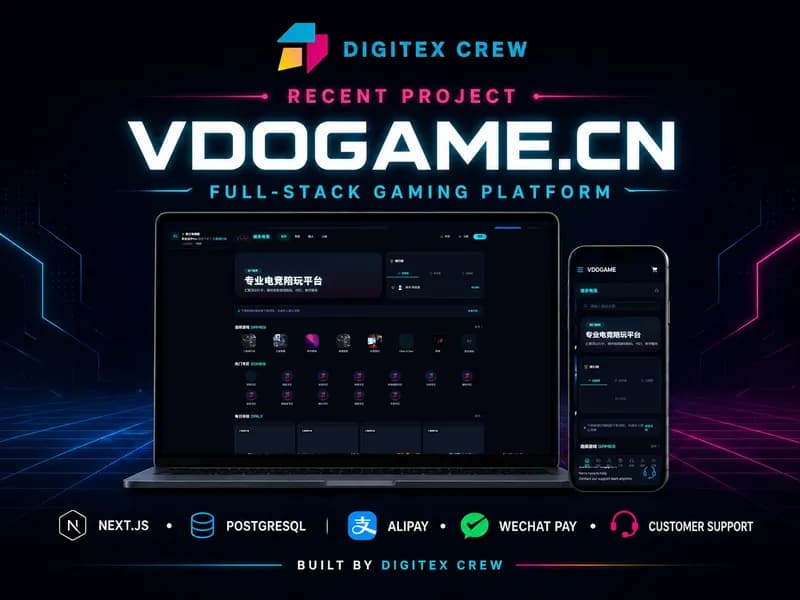
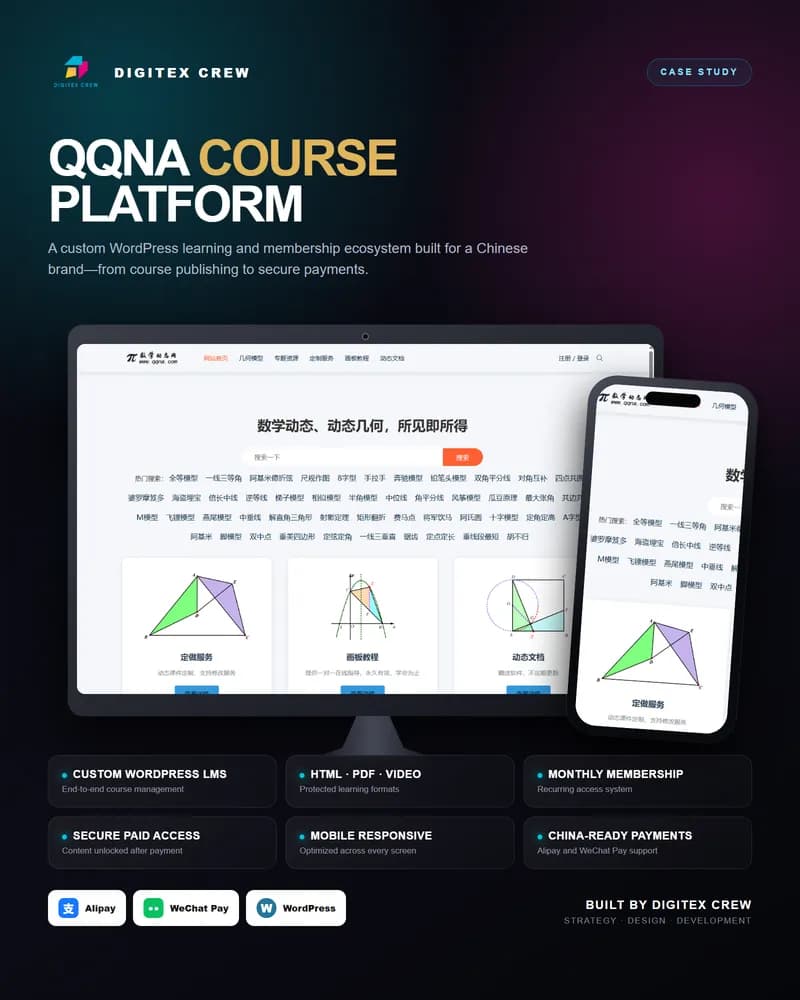
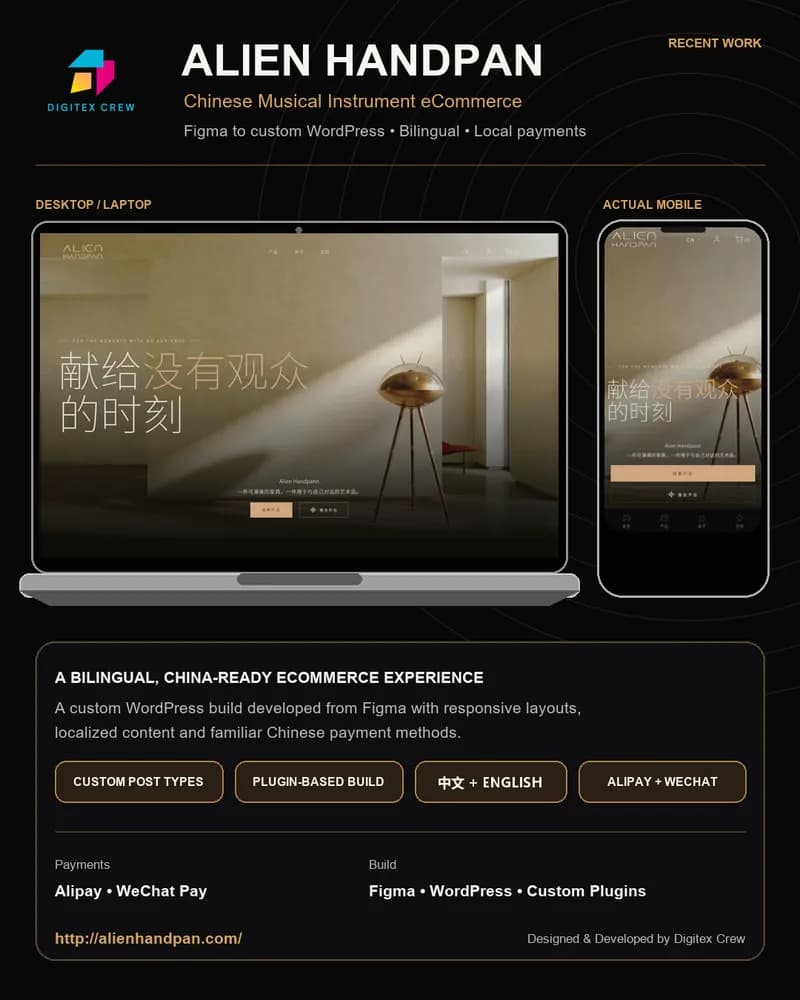
Four recent builds from our North York studio — a 195,000-product wholesale platform, a full-stack marketplace, a custom WordPress LMS, and a bilingual store. Every one designed, developed, and deployed by our team.
A Chinese-language B2B wholesale storefront serving anime-merchandise retailers worldwide — a huge live catalog with product search, JAN-code lookup, wholesale pricing, wishlists, cart, and checkout.
Full-stack gaming-service platform for the Chinese market, with separate seller, customer, and admin tiers, built-in customer support, secure data handling, and the payments Chinese customers actually use.
An approved Figma design translated pixel-faithfully into a premium bilingual (English/Chinese) instrument store — custom post types the client manages themselves, and a China-ready checkout.
Layouts planned around the actions you want visitors to take — call, book, quote.
SEO-ready structure from day one
Clean URLs, schema markup, meta strategy, and page-speed work baked into the build.
Lead capture that actually routes
Forms, click-to-call, and booking hooks wired to your inbox and phone.
Responsive on every screen
Tested across the phones Toronto customers actually use, not just desktop mockups.
Plain-language analytics
You see calls, form fills, and rankings — not a wall of dashboards.
Launch and handover
We stay through go-live and show you how to edit the parts you should own.
Under the hood
Every Build Ships With All Five Layers
Most agencies sell you a design and quietly skip the rest. Our builds stack five layers into every project from day one — so the site looks right, loads fast, ranks on Google, and turns visits into calls. Nothing is an upsell later.
No page leaves staging without passing our mobile and speed checks
Schema, sitemaps, and metadata wired in before launch — not after
Forms and call tracking tested with real submissions, not just clicked once
How a Digitex Crew Website Gets Built
Five phases, each signed off before the next begins. No mystery, no scope creep.
PHASE 1
Discovery
We map your services, customers, and the searches you need to win — then agree on scope and a fixed CAD quote.
PHASE 2
Architecture
Page-by-page structure, message hierarchy, and the keyword each page targets. Nothing gets built until the plan is right.
PHASE 3
Design
A look that matches your trade and your market — reviewed with you, revised until it fits.
PHASE 4
Build
Server-rendered pages, structured data, image optimization, and forms. Built to load fast on Canadian mobile networks.
PHASE 5
Launch & measure
We index, verify, and watch the first weeks of real traffic with you — then report what it did.
The process in detail
What Our Website Development Service Includes
The five phases above are the shape of every project; this is what actually happens inside them. Here is the work behind each stage, what we need from you along the way, and what you walk away with when it is done.
Stage 1
Discovery and scoping
Every project starts with a 45-to-60-minute conversation — over video, by phone, or across the table at our North York studio — about what you sell, who your best customers are, and what a good month looks like for you: more calls, more bookings, more quote requests. We review your current website and Google presence if you have them, look at the competitors ranking for your services across the GTA, and list the pages your customers need before they'll pick up the phone. You leave this stage with a written scope: the page list, the features, who supplies what content, a realistic timeline, and a fixed quote in Canadian dollars. Nothing gets built until you approve that document — which is how projects stay on budget.
Stage 2
Site architecture and wireframes
Before any colours or fonts, we plan the skeleton of every page. Architecture means deciding which services get their own page, what order sections appear in, and which search each page is built to win — a page that tries to rank for everything ranks for nothing. Wireframes are simple greyscale layouts: boxes, labels, and real headings, with no decoration to distract from structure. This is where we settle the questions that are expensive to fix later, like where the contact form sits, what proof appears above the fold, and how a visitor moves from landing to enquiring. You approve the full page-by-page plan before design begins, so the project never drifts.
Stage 3
Design
With the architecture signed off, we design the look and feel: colours, typography, imagery style, spacing, and the small interactions that make a site feel professional rather than assembled. Wherever possible we design with your real content — your services, your photos, your reviews — because layouts built around placeholder text always look worse once real words land in them. You review complete pages, not scattered fragments, and we revise until the design feels like your business. A good design has two jobs: it must look credible to a first-time visitor within seconds, and it must make the next step — call, book, or request a quote — obvious without hunting for it.
Stage 4
Development
This is where the approved design becomes a working website: semantic HTML, server-rendered pages, optimized images, structured data markup, forms with spam protection, click-to-call buttons, and embedded maps. Performance is a budget here, not an afterthought — we measure load times on real phones over Canadian mobile networks, not just office Wi-Fi, because your customers in Scarborough, Etobicoke, or Mississauga will often meet your site for the first time on a phone in a parking lot. From the first week of the build you get a private staging link, so you watch the site take shape and click through real pages instead of waiting for a big reveal. Feedback early, in the browser, is always cheaper than feedback after launch.
Stage 5
Content and copywriting
Design carries the first impression; content does the selling. You can supply your own text and we will edit it for the web — shorter paragraphs, clear headings, one idea per section — or we write it for you. Our copywriting process is an interview, not a homework assignment: we ask about your services, your customers, and what makes you different, you talk, and we draft the pages in plain language for your approval. We also guide photography, because real photos of your team, your shop, and your finished work consistently outperform stock imagery. Every page leaves this stage with a search-focused title, a meta description, and headings that match the way Toronto customers actually search.
Stage 6
Launch
Going live is a checklist, not a leap. Before launch we run a final pass: page-speed checks on mobile and desktop, every form tested with real submissions so nothing silently fails, analytics and call tracking verified, an XML sitemap submitted to Google Search Console, and — if we are replacing an existing site — 301 redirects mapped page by page so the rankings you have already earned transfer to the new build. We handle the DNS, the SSL certificate, and the timing, and we schedule go-lives so your site is never down during business hours. A proper launch day is boring: the new site replaces the old one, forms start arriving, and nothing breaks.
Stage 7
Post-launch support
A website is a business asset, not a poster — it needs care after launch. Every build includes a post-launch window where we fix anything that surfaces once real visitors arrive, and an early report that shows what visitors did, where they came from, and what we would improve next. If you want ongoing peace of mind, our care plans cover software updates, backups, security monitoring, uptime checks, and small content edits — all month-to-month, with no long lock-in contracts. You also get a handover walkthrough, recorded so you can replay it, showing how to edit the parts of the site you should own. Your website, your domain, your content — you own all of it.
Website Design Services for Every Kind of Toronto Business
Whether you need affordable website design in Toronto, an ecommerce storefront, a WordPress developer, or a construction site that wins quote requests, the process is the same: plan the pages around real searches, build fast, launch clean. Ranges for each build type are broken down on our pricing page and in our guide to what a website costs in Toronto.
Affordable Websites for Small Budgets
Affordable website design in Toronto does not mean a template with your logo pasted in. We scope a focused five-to-eight-page site around the pages that win searches and drive calls, phase the rest, and fix the quote in CAD before work starts — most land between $3,000 and $12,000.
Ecommerce Website Design
Shopify or custom-coded storefronts with Canadian tax rules, GTA shipping zones, and checkout tuned for phone buyers. Product photography guidance, collection structure, and the schema markup that gets products into Google — built so a Mississauga or Vaughan customer can buy in under a minute.
WordPress Development & Migrations
Need a WordPress developer in Toronto, or a way off an aging WordPress site? We build on WordPress when self-editing matters, migrate off it when speed and security matter more, and either way protect your existing rankings through the move with proper redirects.
Construction & Trades Websites
Construction website design is its own discipline: before-and-after project galleries, quote-request funnels, licence and WSIB proof points, and service-area pages for North York, Scarborough, Etobicoke, and beyond. Built for contractors whose next job comes from a phone search at 7 a.m.
Types of websites
Types of Websites We Build for Toronto Businesses
Every category below is built the same way — planned around real searches, priced in Canadian dollars, mobile-first, and SEO-ready from the first line of code — but the deliverables differ. Here is what each type involves and who it tends to suit.
Business and Service Websites
The most common thing we build for GTA small businesses: a five-to-twelve-page site with a homepage, one dedicated page per service, an about page, a contact page, and proof — reviews, project galleries, or before-and-after photos. The whole build is oriented toward one outcome: a visitor contacting you. That means click-to-call on every page, quote forms short enough to finish on a phone, directions and parking details for your location, and service-area pages that name the neighbourhoods you serve, from North York to Vaughan. If your next customer is comparing three businesses on Google at 7 a.m., this site is built to win that comparison.
eCommerce Stores
For selling online we recommend Shopify when you want to launch fast on a proven platform, WooCommerce when you are already on WordPress, or a custom-coded storefront when speed, scale, or unusual features demand it — like the 195,000-product wholesale platform in our portfolio. Beyond the storefront itself, we set up the parts that actually determine whether a store sells: product and collection structure, product photography guidance, Canadian tax handling, shipping zones that reflect GTA realities, payment gateways, order confirmation emails, and abandoned-cart recovery. A store that merely lists products is a catalogue; we build the version that closes the sale.
WordPress Websites
We build on WordPress when you want to edit your own content with familiar tools — and we will tell you honestly when a different stack would serve you better. Our WordPress builds use a lightweight theme and the block editor, not a bloated page builder that slows every page load, and every build includes a recorded training walkthrough so your team can add pages, posts, and photos with confidence. We also migrate sites onto and off WordPress: the critical piece is redirect mapping, so the rankings your old pages earned follow the move instead of evaporating. Plugin updates, backups, and security monitoring can sit with a care plan or your own IT — your call.
Bilingual Chinese-English Builds
The GTA is home to one of the largest Chinese-speaking communities in North America, and a properly bilingual website puts your business in front of it. This is not a machine-translation button pasted in the corner: it means professionally written Chinese copy, correct typography and fonts, language-aware page structure so Google indexes and serves each version properly, and the contact and payment preferences Chinese-speaking customers expect — WeChat contact, Alipay or WeChat Pay alongside Canadian options. We have shipped bilingual builds including the Alien Handpan store and Chinese-market platforms like VDOGAME CN and Bafantangrigu, so the workflow is proven. For businesses serving Richmond Hill, Markham, or north Scarborough, bilingual capability is often the single biggest conversion lever available.
Booking and Appointment Websites
Clinics, salons, tutors, cleaners, and trades all share one goal: a calendar that stays full without the phone tag. We build booking sites with real scheduling integration — service menus with clear pricing, staff or practitioner pages, deposit collection at the time of booking, and automated reminder emails or texts that cut no-shows. Add before-and-after galleries for aesthetics and renovation work, intake forms that collect the details before the appointment, and review widgets placed where hesitant visitors look for reassurance. The result is a website that books work while you are doing the work.
Tools we build with
A Modern Stack, Chosen for Your Project — Not Our Convenience
Custom Next.js builds when speed and scale matter. WordPress when you want to edit content yourself. Shopify when you want to sell out of the box. We recommend the stack that fits your budget and team — and tell you honestly when the cheaper option is the right one.
Why Toronto Businesses Choose Our Web Design Team
We work from 1315 Finch Ave W, Toronto — close enough to sit across the table from you, and embedded enough in the local market to know what converts here. A website for a North York contractor, a Scarborough clinic, or an Etobicoke retailer gets planned around the searches real Toronto customers run, the neighbourhoods they name, and the way they compare options.
That local fluency is also why our builds pair naturally with local SEO services — the site and the rankings are designed together, not bolted on afterwards. Curious what that costs? Our Toronto web design pricing page shows honest CAD ranges, and our breakdown of how much a website costs in Toronto explains exactly where the money goes.
Pricing, honestly
How Much Does a Website Cost in Toronto?
Website pricing in Toronto honestly runs from a few hundred dollars to six figures, and most of that spread is real. What matters is what you actually get at each level. Here are the ranges we quote for the work described on this page — in Canadian dollars — so you can budget against real numbers instead of agency hand-waving.
$1,500 – $3,000
Starter or one-page website
A single, well-built page with sections, a contact form, click-to-call, and basic local SEO. Right for brand-new businesses testing demand, or trades that live on referrals and simply need a credible home on Google.
$3,000 – $8,000
Small business website (5–10 pages)
The range most of our Toronto service-business builds land in. Custom design, a page per service, reviews and gallery integration, local SEO foundations, and a launch-ready build — the workhorse category for GTA owners.
$8,000 – $15,000
Larger sites with copywriting (10–25 pages)
More services and service-area pages, a blog or resource section, and professional copywriting throughout. The page count and the writing are what move the price here — not fancier technology.
$5,000 – $25,000+
eCommerce builds
Storefront plus product structure, payments, Canadian tax and shipping setup, and the operational emails a store needs. Large catalogues, wholesale pricing tiers, or unusual integrations sit at the top of the range.
$15,000 and up
Custom web applications
Marketplaces, membership platforms, dashboards, and multi-role systems like the builds in our portfolio. Scoped feature by feature before a dollar is committed, so you know exactly what each phase buys.
What moves the price up
Page count — every additional page is design, build, and content work
Professional copywriting across the whole site
Custom design concepts versus a proven layout system
Integrations: booking systems, payment gateways, CRM or inventory feeds
Bilingual Chinese-English versions of every page
Product photography or a scheduled photo shoot
Migrating an existing site while preserving its rankings with redirects
What keeps the price down
A tight, well-defined scope agreed before work starts
Content and photos ready before the build begins
Phasing: launch the core site now, add sections in affordable later phases
Choosing a proven layout system over a from-scratch design concept
Limiting the first build to the pages that win searches and drive calls
Be wary of both ends of the market. The $500 template special usually costs more later: slow pages, no SEO structure, nobody answering the phone when something breaks, and sometimes a nasty discovery that you do not even own the site. At the other extreme, a downtown agency quoting $40,000 or $50,000 is often pricing a brand-strategy program a North York contractor simply does not need. A fixed quote from a small local team tends to land exactly where the value is. And remember the modest ongoing costs — a domain (roughly $20 a year), hosting (typically $20 to $60 a month depending on the stack), and an optional care plan. We itemize all of them before you sign anything.
Where do DIY builders like Wix, Squarespace, or a Shopify template fit? Honestly, they are the right answer for some businesses. If you have more time than budget, need something simple this week, and are comfortable doing the design and copywriting yourself, start there. The trade-offs show up later: template sites share their layout with thousands of others, page builders add code bloat that slows load times, SEO control is limited, and migrating to a custom build later usually means starting over. Our advice is simple — if the site is a hobby, do it yourself; if it is how your business wins customers, treat it like the asset it is and budget accordingly.
How Long Does a Website Take to Build?
Timelines depend on scope, but they depend even more on decisions — yours and ours. Here are the ranges we commit to in writing, based on projects moving at normal pace with feedback arriving within a few business days:
One-page starter site2–3 weeks
5–10 page service business site4–6 weeks
10–25 pages, with copywriting6–10 weeks
eCommerce store8–12 weeks
Custom web application12–20+ weeks
What actually moves the timeline
Content readiness
The single biggest variable. Sites rarely stall on code; they stall waiting on photos, text, and logo files. Our copywriting service exists largely because it removes this bottleneck.
Feedback speed
Designs approved within a day or two keep momentum. Every week a review sits in an inbox adds a week to the calendar — we send reminders, but the pace is genuinely shared.
Where changes happen
Adjustments at the wireframe and design stages are quick. Changes after the build starts mean reworking code, which is why we front-load every decision into those two stages.
Integrations and photography
Booking systems, payment gateways, and inventory feeds each need real testing time, and scheduling a photo shoot typically adds a week. We flag these in the written timeline up front.
We keep dates honest with a staging link from week one, progress updates directly from the people building your site — no account-manager relay — and a launch date agreed in writing before work begins. If a delay is ever on our side, we tell you early and adjust the plan with you, not after the deadline has already passed.
Beyond good looks
Why a Conversion-Focused Website Matters More Than a Pretty One
Plenty of Toronto businesses have websites they paid good money for that produce nothing — no calls, no forms, no sales. Almost always the design looked fine; the problem sat underneath. A conversion-focused build treats four things as non-negotiable:
Speed
Every additional second of load time costs you visitors — and Google folds page experience into rankings, so slow sites pay twice. We budget performance from the first line of code: optimized images, server-rendered HTML, minimal JavaScript, and testing on real Canadian mobile connections rather than a developer's gigabit office line.
Mobile-first design
The majority of local searches happen on a phone — a contractor looked up at 7 a.m., a clinic booked from a parking lot, a restaurant checked mid-commute. Mobile-first means the site is designed for a thumb on a small screen first, then scaled up: tap-to-call buttons within reach, forms that don't punish typing, directions one tap away. A desktop site that merely works on mobile leaks the majority of your traffic.
Local SEO foundations
Rankings are built into the site from day one: clean URLs, one page per service so each can rank for its own searches, LocalBusiness schema markup, embedded maps with consistent name-address-phone details, and a properly linked Google Business Profile. A beautiful site that Google cannot parse or match to local searches is a brochure nobody sees — the architecture stage exists precisely so this layer is planned, not hoped for.
Trust signals
Visitors decide whether to contact you within seconds, mostly from trust cues: real reviews visible on the pages that matter, genuine photos of your work instead of stock, licences and insurance stated plainly (WSIB matters to trades customers), clear next steps, and contact details that match your Google profile exactly. Each signal is small; together they are the difference between a visitor who calls and one who keeps comparing.
None of this is exotic — it is discipline. Every decision in our builds traces back to one question: does this make a visitor more likely to contact you? If the answer is no, it does not make the cut, no matter how nice it looks in a mockup. That is the difference between a website that decorates your business card and one that pays for itself.
Before you sign anything
How to Choose a Web Design Company in Toronto
Toronto has hundreds of web design providers — solo freelancers, downtown agencies, offshore teams, and do-it-yourself platforms. The right choice for a small business usually comes down to a shortlist of questions you can ask any of them, plus a few warning signs that should end the conversation early.
Questions Worth Asking Any Provider
Who actually builds my site — the people I meet, or someone I've never spoken to?
Accountability matters. With a small local team, the strategist, designer, and developer you talk to are the ones doing the work. With a relay structure, details get lost between the salesperson and the builder — and you pay for the friction.
Do I own the domain, hosting, content, and code — and will you put that in writing?
Some providers register your domain under their own account or build on locked platforms, which makes leaving expensive or impossible. Ownership terms should be stated plainly before you sign, not discovered during an argument.
What exactly is included — copywriting, photography, SEO setup, analytics — and what costs extra?
Two quotes rarely cover the same ground. A cheap quote that excludes copywriting, local SEO setup, and form testing stops being cheap by invoice three. Ask every bidder to list the same line items so the numbers are comparable.
Can I see live client websites and speak with a past client?
Mockups are easy; launched, working sites are the real portfolio. Ask for URLs you can click through on your phone, and one reference you can call. A team confident in its work will arrange both without hesitation.
What happens after launch, what does ongoing support cost, and am I locked in?
Launch day is the start of the site's life, not the end of the project. Ask who fixes things when they break, how updates are handled, and whether the support arrangement is month-to-month. Long lock-in contracts usually protect the provider, not you.
Is the quote fixed, and what would legitimately change the price?
A fixed quote after a proper scope call is a sign of a team that has done this many times. Hourly arrangements and vague estimates shift risk onto you. Ask what happens if you add a page mid-project — the answer reveals how change is handled.
How will we measure whether the website is working?
Calls, form submissions, bookings, sales — agree on the numbers before the build starts, and make sure analytics are set up under your ownership. A team that talks about measurement expects to be held to results.
Red Flags to Walk Away From
A quote that arrives minutes after your first email, with no scope conversation — a number without a plan is a guess, and guesses get revised upward.
“Guaranteed #1 on Google” — no honest company guarantees rankings. Legitimate SEO improves them over months of consistent work.
No staging link and no access to your own analytics — if you cannot watch the build or see the data, you are buying a black box.
Ownership terms that are vague or missing entirely — the classic trap is a domain registered in the agency's name, not yours.
A portfolio full of mockups and concepts rather than live URLs you can visit and click around.
High-pressure tactics and long lock-in contracts — a confident team sells month-to-month and lets its work keep you.
Proposals that never mention your customers, your neighbourhood, or the searches people run to find you — that is a brochure vendor, not a marketing partner.
What does a good first call look like? They ask about your business and your customers before they talk technology or price. They mention the searches people run in your market and the competitors showing up for them. They explain trade-offs — WordPress versus custom, template versus bespoke design — in plain language, including when the cheaper option is the right one. And you leave the conversation with a written scope and a fixed quote, not a spot in a sales funnel. If that sounds like the standard you want to hold us to, start with a discovery call: we will audit your current online presence, map the pages your customers need, and quote the build in Canadian dollars — no pressure, and no follow-up barrage.
Web Design in Toronto — FAQs
Most custom small-business websites we build land between $3,000 and $12,000 CAD depending on page count, content work, and integrations. Ecommerce builds start higher. Every project gets a fixed quote after a scope call — no hourly surprises, and the full breakdown is on our pricing page.
A focused service-business site typically launches in 3–6 weeks once content is confirmed. Ecommerce and integration-heavy builds take longer — sometimes 8–12 weeks. We agree the timeline in writing before work starts, and you see progress on a staging link from week one.
Yes — every build ships with technical SEO included: clean URLs, schema.org markup, meta structure, image optimization, and local SEO foundations like your Google Business Profile connection. If you have an existing site, we migrate it without losing rankings. Ranking for competitive terms takes ongoing SEO work.
Yes. A focused five-to-eight-page business website can start around $3,000 CAD, and we can phase larger builds so you launch sooner and expand later. We would rather scope honestly to your budget than quote a bloated site — see our pricing page and Toronto cost guide for real ranges.
Both, and we will tell you honestly which fits. WordPress suits businesses that want to edit content themselves with familiar tools; custom-coded sites suit owners who want maximum speed, security, and design control. Either way, the site is SEO-ready, mobile-first, and easy for your customers to use.
At minimum: Home, Services (one page per service), About, Contact, and proof — reviews, portfolio, or before-and-after galleries. Toronto service businesses usually add neighbourhood or service-area pages for North York, Scarborough, or Mississauga searches. We map the exact page list to the keywords you need to win first.
Our office is at 1315 Finch Ave W in North York and most clients are in Toronto, Scarborough, Etobicoke, Mississauga, and Vaughan — but we work remotely with businesses across Canada. Discovery calls, reviews, and handover all work fine over video if you are outside the GTA.
More Questions Toronto Owners Ask About Web Design
No — though you can if you'd like. Most clients choose our copywriting service: we interview you about your services, customers, and what makes your business different, then draft every page in plain language for your approval. You stay in control of facts and tone; we handle structure, search-focused headings, and editing. Even clients who write their own text get our web-editing pass, because text written for print or borrowed from other materials rarely reads well online — and small fixes there make an outsized difference.
Yes. Every build ships with an editing walkthrough — recorded so you can replay it — covering the parts of the site you'll reasonably want to touch: text, photos, prices, hours, blog posts. WordPress builds use the familiar block editor; custom builds get a straightforward content panel. And if you'd rather never touch it, care-plan clients simply send us the changes and we make them, usually within a business day. Either way, you are never hostage to a developer for a phone-number change.
Both. A redesign usually starts with an audit: what your current site ranks for, which pages earn traffic and leads, and what is technically holding it back. We keep whatever is working — migrating content and mapping 301 redirects page by page so rankings follow the move — and rebuild whatever is not. Sometimes the honest answer after an audit is that your current site needs targeted fixes rather than a full rebuild. We will tell you that too, because a smaller project you need beats a larger one you don't.
Every build includes a post-launch period where we fix anything that surfaces once real visitors arrive, at no charge. Beyond that, our optional care plans cover software updates, daily backups, security monitoring, uptime checks, and small content edits — all month-to-month, with no long lock-in contracts. Because we are a small local team, the person who answers your email is the person who built your site, and urgent issues get a same-day response during business hours rather than a ticket number.
Yes — and we put it in writing. Your domain is registered in your name or transferred to you, hosting and admin access are handed over at launch, and the design, code, and content are yours. Some cheap providers build sites on locked platforms you can never move; we build on standard, portable technology, so if you ever want to host or maintain the site elsewhere, it moves cleanly. Your Google Analytics and Search Console properties are set up under your ownership as well, not ours.
The people doing the work. Digitex Crew is a small local team, and the strategist, designer, and developer on your project are the ones you will talk to — on discovery calls, in progress updates, and after launch. There is no account-manager relay and no offshore handoff. You can reach us by email at contact.digitexcrew@gmail.com or by phone at +1 709-600-9358, and for GTA clients we are also happy to meet at our North York studio at 1315 Finch Ave W.
Yes — bilingual Chinese-English builds are a specialty. A proper bilingual site goes far beyond a translation widget: it means professionally written Chinese copy, correct fonts and typography, language-aware structure so Google indexes and serves each version properly, and the contact and payment preferences Mandarin- and Cantonese-speaking customers expect, including WeChat contact and Alipay or WeChat Pay. For businesses serving Richmond Hill, Markham, North York, or Scarborough, it is often the highest-impact feature a website can have.
Request a Quote — Web Design & Development
Ready for a Website That Works for Your Business?
Tell us what you do and who you want to reach. We'll come back with a plan and a fixed quote in Canadian dollars.