
15 Rules of SEO: The Checklist That Actually Moves Rankings
Google's algorithm weighs hundreds of signals, but a small business does not need to master hundreds of things. In our work with Toronto clients, fifteen rules consistently produce most of the ranking movement. Run them in order, run them monthly, and the compounding does the rest.
The 15 rules of SEO are the practices that reliably move rankings: target winnable keywords, match search intent, publish genuinely useful content, earn real backlinks, keep the site fast and crawlable, and measure leads instead of vanity metrics. Everything else — the plugins, the hacks, the "one weird trick" tactics — is either a detail of one of these fifteen or a distraction from them. The scorecard below is the same audit sequence we run for clients; each rule below explains what it means and how to execute it.
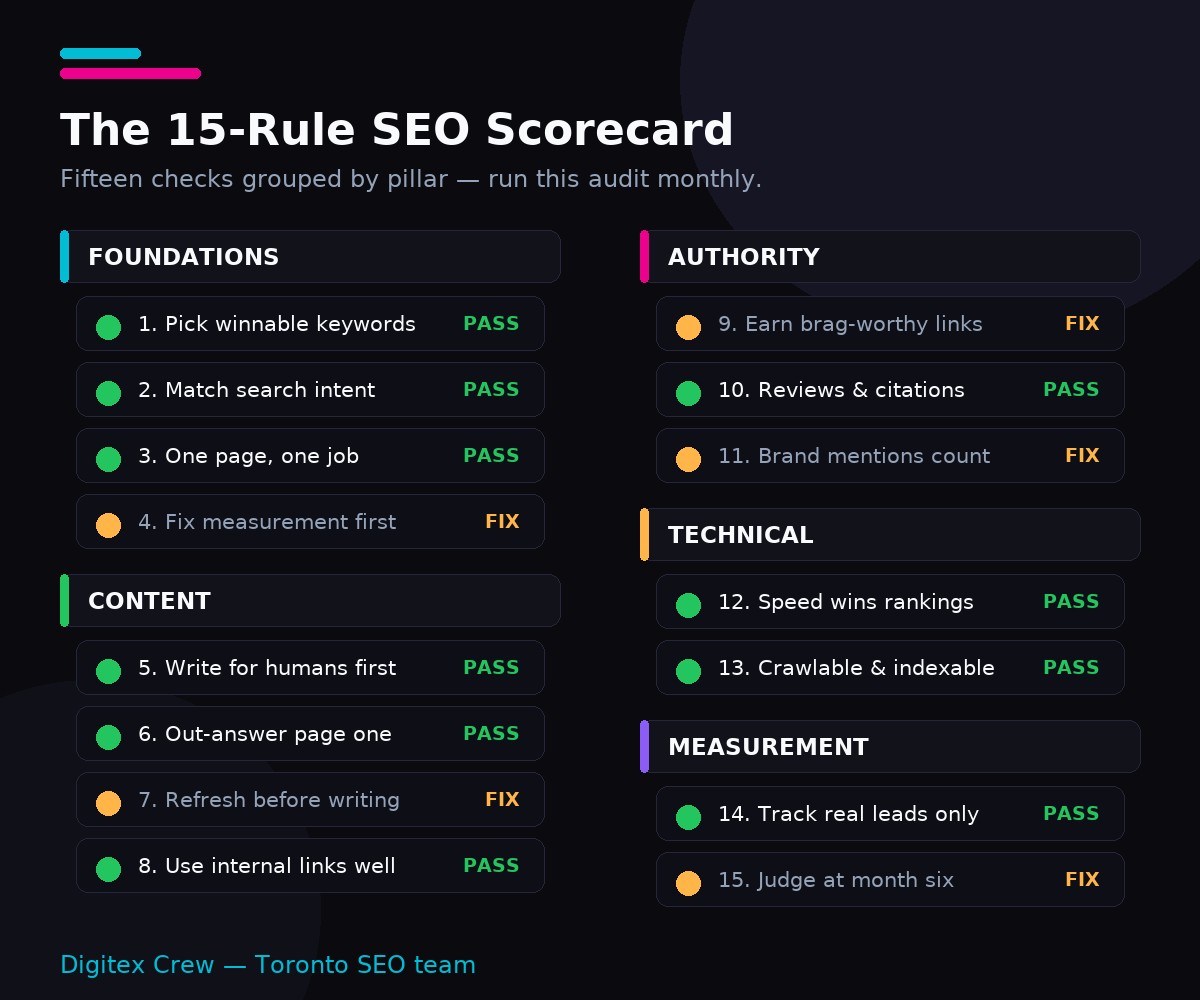
Rules 1–4: Foundations before anything else
Most failed SEO campaigns were broken on day one — wrong keywords, wrong intent, or no measurement in place to even know what worked. These four rules come first, in this order, because everything else builds on them.
- Rule 1 — Target keywords you can actually win. A Toronto plumber will not outrank Roto-Rooter for "plumber" this year, but "emergency plumber finch and keele" or "tankless water heater install north york" is winnable within months. Build your list from the specific: service + neighbourhood, buyer-intent phrases, and the questions customers ask on the phone. Free tools — Google Search Console, autocomplete, and the "People also ask" box — surface most of it.
- Rule 2 — Match the intent behind the keyword before you write a word. Search "jaguar" and Google has to decide: the animal, the car, or the football team? It decides from the behaviour of previous searchers. Look at what currently ranks for your keyword: if page one is all service pages, a blog post will not rank, and vice versa. Your job is to give the searcher the format they already proved they want.
- Rule 3 — One page, one job. Two pages targeting the same keyword split your authority and confuse Google about which to rank (this is called keyword cannibalization, and it quietly caps rankings for many small sites). Decide which page owns which keyword, merge or redirect the duplicates, and keep a simple map: one primary keyword, one page.
- Rule 4 — Fix measurement before you fix rankings. Install Google Search Console and analytics with conversion tracking — calls, form fills, bookings — before touching anything else. Without a baseline, month six arrives and you are arguing about whether SEO worked instead of reading the number. This is also the rule that protects you from bad agencies: if a provider cannot show you the dashboard, walk away.
Rules 5–8: Content that deserves to rank
Google's job is to give the searcher the best answer. Rules 5–8 are about making yours demonstrably the best answer on page one — not the longest, not the most keyword-stuffed, the best.
- Rule 5 — Write for humans first, structure for Google second. Clear headings that mirror how people actually ask, short paragraphs, lists where lists help, and a direct answer near the top of the page. Structure is not decoration: it helps Google extract answers for featured snippets and AI overviews, which is increasingly where clicks come from.
- Rule 6 — Answer the question better than anyone currently on page one. Open the top five results for your keyword and catalogue what they cover. Then cover it more precisely, add the details they skip (real prices, real timelines, real local detail), and make the next step obvious. A page that out-answers the competition earns the click even at position three; a page that rehashes it ranks nowhere regardless of optimization.
- Rule 7 — Refresh stale pages before writing new ones. Updating an existing page that already has rankings and links is the highest-leverage content work there is: Search Console shows you which pages are stuck at positions 11–30, and a genuine update — new numbers, better sections, tighter answers — lifts them faster than a new post from zero. Aim for a content refresh cycle on your money pages every 6–12 months.
- Rule 8 — Use internal links on purpose. Every important page should be reachable in one or two clicks from the homepage, and your blog posts should link to your service pages with descriptive anchor text. Internal links distribute the authority your site earns and tell Google which pages matter most. A five-minute internal-link pass each month outperforms most "SEO tricks."
Rules 9–11: Authority you cannot fake
Links remain the heaviest single ranking factor, and they are also where small businesses get into trouble. These three rules build authority that survives algorithm updates — because it is real.
- Rule 9 — Earn links you would happily show a customer. A link from the Toronto Star, an industry association, a supplier's partner page, or a local charity you sponsor carries real weight; a link from a $50 "SEO package" carries risk. The honest formula is slow and simple: create the resource people in your industry actually reference (pricing data, how-to guides, local maps), then tell the people who would care.
- Rule 10 — Reviews and citations are links' local cousins. For local rankings, Google Business Profile reviews and consistent name-address-phone citations across the web act as authority signals. Ask every happy customer at the moment they are happiest, reply to every review, and keep your NAP identical everywhere — same spelling, same suite number, everywhere.
- Rule 11 — Brand mentions count, even without links. Google reads unlinked mentions of your business name as a trust signal, and they compound: sponsor the local team, get quoted in neighbourhood publications, show up in "best of" roundups. Consistent brand mentions make every other authority signal more believable.
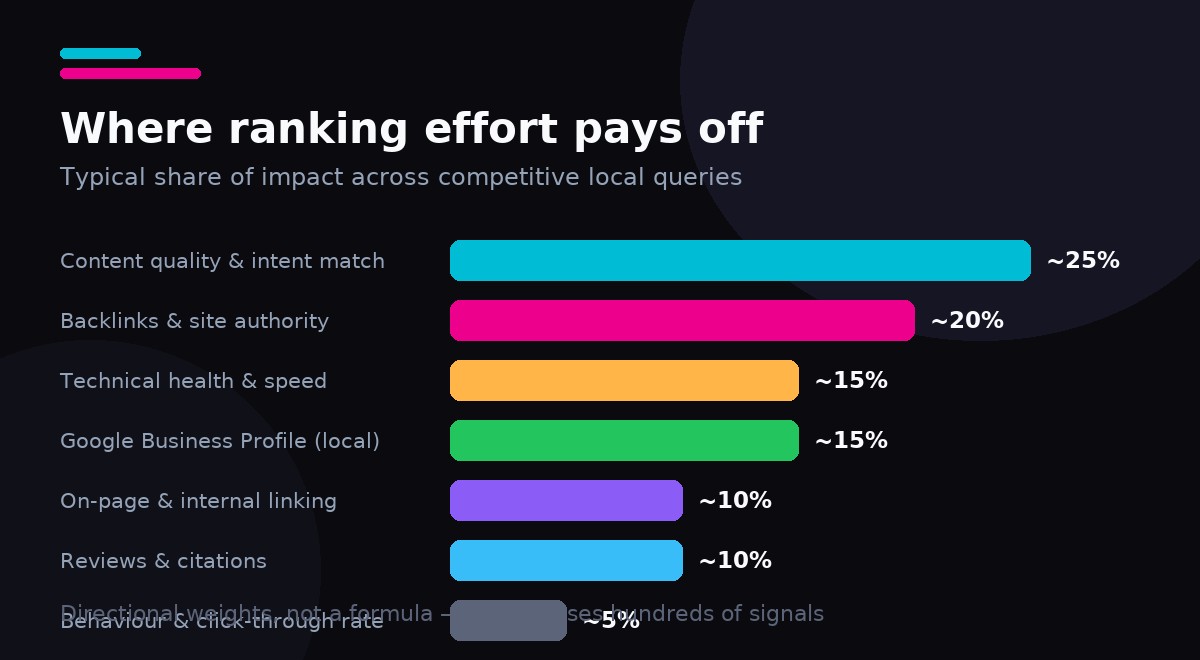
Rules 12–13: Technical health is hygiene, not strategy
Technical SEO will not win you rankings on its own, but it quietly decides whether anything else works. Think of it as hygiene: two rules cover what small business sites actually need.
- Rule 12 — Speed is a ranking factor and a conversion factor. Core Web Vitals measure real loading experience; sites that pass convert better and rank a little easier. The wins for most small sites are unglamorous: compress images, lazy-load below-the-fold media, drop the slider and autoplay widgets, and use decent hosting. A page that loads in under two seconds on a phone is competitive; one that loads in five is bleeding both rankings and customers.
- Rule 13 — If Google cannot crawl and index it, nothing else matters. Check Search Console's Coverage report monthly. One stray robots.txt line, a noindex tag copied from a staging site, or thousands of duplicate pages generated by a plugin can nullify months of good work. Also make sure your site has one canonical version (https, with or without www — pick one and redirect the rest) and an XML sitemap submitted in Search Console.
Rules 14–15: Measure what pays the bills
The final two rules decide whether SEO produces revenue or just reports.
- Rule 14 — Track leads and revenue, not vanity metrics. Impressions, rankings, and even raw traffic can all rise while the phone stays silent. The metrics that matter are calls, form submissions, bookings, and revenue by channel. Set up conversion tracking on day one (rule 4), and judge every SEO decision by whether it moves those numbers.
- Rule 15 — Give it six months before you judge. SEO compounds: the work in months one and two is invisible by design, and the curve bends around months four to six. This is the single most common way small businesses sabotage themselves — quitting at week eight, right before the payoff. Set the expectation now: budget six months, then read the results honestly and decide.
What results look like
For a Toronto small business running these fifteen rules consistently, the honest timeline looks like this: technical fixes and measurement live in weeks one to four; first ranking movement shows in months two to three on winnable keywords; meaningful traffic growth shows in months four to six; and the compounding — where SEO starts outpacing paid ads on cost per lead — arrives in months six to twelve. The curve below is illustrative, but the shape is reliable across the local businesses we work with.
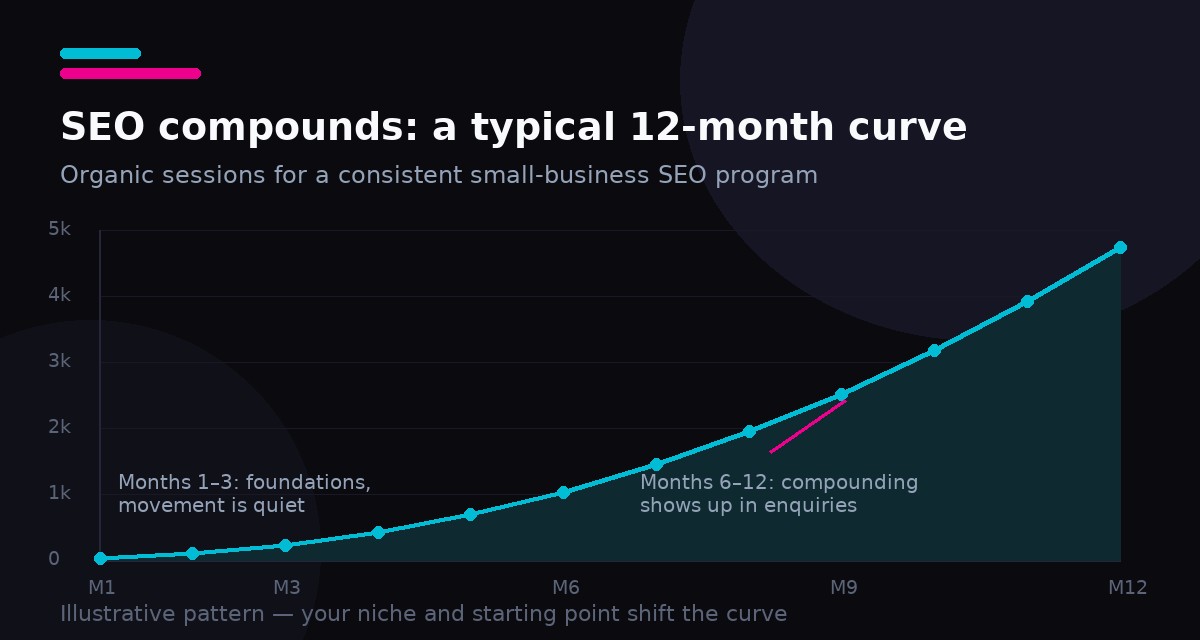
The scoreboards that matter are in Search Console (impressions, clicks, average position on your target keywords) and in your call and form tracking. If those three numbers are trending up at month six, the program is working — whatever any single ranking on any single day says.
When to bring in a Toronto SEO agency
These fifteen rules are genuinely DIY-able if you have five hours a week and a single location. Bring in help when you are competing against funded players, running multiple locations, or when technical issues — site speed, indexing, migrations — stall progress. A good agency shows you the same dashboards it uses, explains changes in plain language, and never locks you into a year-long contract. Our SEO services in Toronto follow exactly this fifteen-rule sequence with monthly reporting, and you can book a free consultation to see where your site stands against each rule before committing to anything.
Frequently asked questions
What are the most important SEO rules?
If forced to pick three: match search intent (rule 2), out-answer page one (rule 6), and earn links you would brag about (rule 9). Content that genuinely answers the searcher's question better than everything else, promoted to the people who would reference it, beats every technical trick — but technical hygiene (rules 12–13) and honest measurement (rules 4 and 14) decide whether the effort shows up in your revenue.
How long do the 15 rules take to work?
Expect visible ranking movement in two to three months on winnable keywords and meaningful traffic growth in four to six months. Toronto is Canada's most competitive local market, so a brand-new site takes longer than an established one. The curve compounds: months six to twelve usually outperform months one to six combined, which is why rule 15 — judging at month six, not week six — matters so much.
Can I do SEO myself or do I need an agency?
The foundations, content, and measurement rules (1–8, 14–15) are learnable by any business owner with a few hours a week. Technical and authority work (rules 9–13) is where agencies earn their keep — not because the concepts are secret, but because the execution is time-consuming and mistakes are expensive. Many of our clients run the content side themselves and hire us for the technical and link-building work; a split arrangement like that is often the best value.
Get Your Free Website & SEO Audit
We inspect your mobile speed, missing local schema markup, and the top 3 competitors outranking you on Google Maps. No sales pressure — just actionable fixes.
About the Author — Digitex Crew
This article was written by the Digitex Crew team — a small, local group of marketers, web designers, developers, and video editors based at 1315 Finch Ave W in North York, Toronto. We serve small businesses across the GTA, including Toronto, Scarborough, Etobicoke, Mississauga, Vaughan, and Markham, and every post on this blog is researched and written by the same people who plan SEO campaigns, build websites, edit videos, and manage social accounts for our clients — not by outside ghostwriters.
When you read advice here, it comes from hands-on work with real local businesses, and it is explained the way we would over coffee: in plain language, with no jargon and no hype. If you are in North York or anywhere else in the GTA, you are welcome to stop by the office or book a call — you will always reach a real person, not a call centre.
Work With Us
If this article raised questions about your own website, search rankings, or social media, we would be glad to help. Here is what we do for small businesses across the GTA:
- Website design & development — WordPress, custom builds, and eCommerce stores that load fast and turn visitors into customers.
- SEO & local SEO — rank in Google and in AI answer engines for the searches your customers actually make in your area.
- Social media marketing — consistent, on-brand content without the daily scramble of posting yourself.
- Video editing & our TikTok Creator Network — polished short-form video that gets attention and builds trust.
We quote everything in Canadian dollars, we never lock clients into long contracts, and you always talk directly to the person doing the work. Explore our services to see what fits, or contact us for a free, no-pressure consultation.
Keep Reading
This post is one of several guides we maintain for Toronto and GTA business owners. If you are working through a specific problem — a website that is not converting, a Google Business Profile that is not showing up in the map pack, or a social channel that is not growing — the rest of our blog covers each of those in the same plain-language, numbers-first style.
Two ways to continue: browse the full blog archive for every guide we have published, or start with our services — the services overview explains what each engagement includes and what it typically costs in Canadian dollars, so you can match the reading to a concrete next step for your business.
If you found this guide useful, the quickest way to apply it is a short conversation. Tell us which post brought you here and what situation you are dealing with — we will point you to the next right step, even if that step does not involve hiring us.
A quick note on how we run this blog: we publish these articles to help small-business owners across Toronto and the GTA understand digital marketing in plain language — what works, what is hype, and where to start. Everything we write reflects how we actually work with clients: honest timelines, realistic budgets, and advice we would happily give a friend who owns a business. If a topic here ever prompts a question, reach out at contact.digitexcrew@gmail.com or +1 709-600-9358 — a short conversation is usually the fastest way to get clarity.